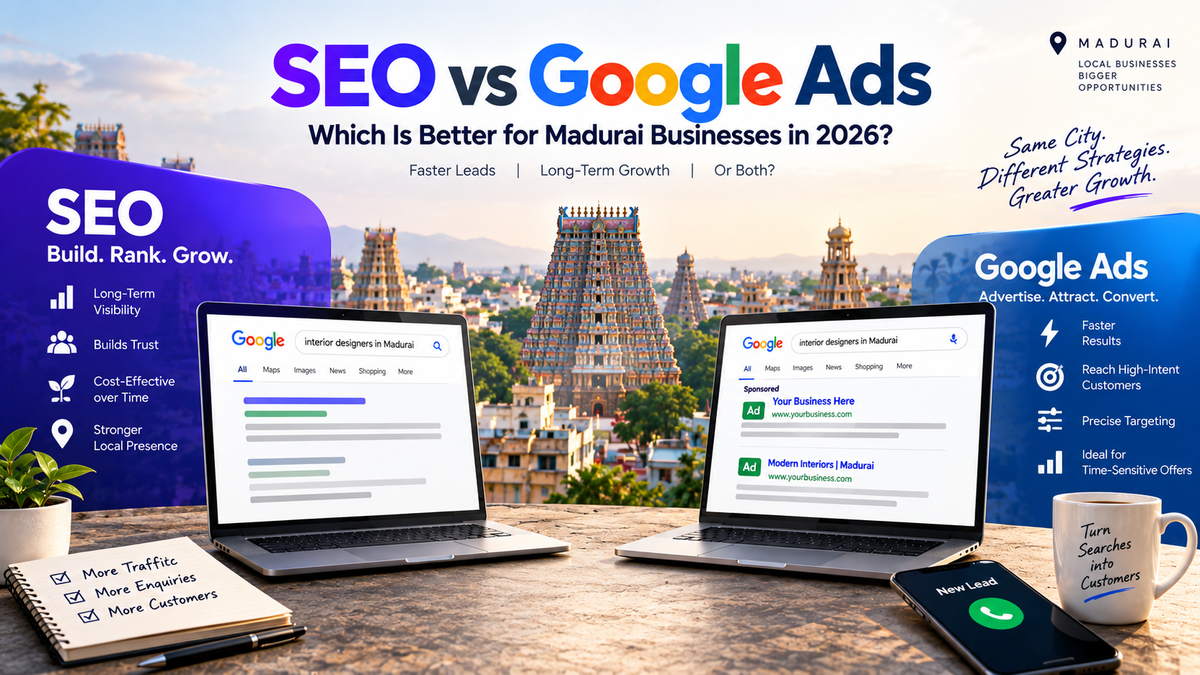
SEO vs Google Ads: Which Is Better for Madurai Businesses in 2026?
If you run a business in Madurai and want more enquiries from Google, you will eventually face one common question:
Should I invest in SEO or Google Ads?
Both can bring potential customers to your business, but they work differently.
Google Ads can put your business in front of people searching for your services quickly. SEO focuses on improving your organic visibility so customers can continue discovering your business through Google Search and other search experiences over time.
So, there is no single answer that works for every business.
The right choice depends on your budget, competition, website, service, urgency and long-term business goals.
This guide explains the difference without trying to declare one channel the winner.
SEO vs Google Ads: Quick Comparison
Factor
SEO
Google Ads
Search visibility
Organic results
Sponsored results
Speed
Usually gradual
Can generate visibility quickly
Cost per click
No direct payment to Google
You pay for ad clicks
Long-term potential
Strong when maintained
Traffic depends on active campaigns
Keyword testing
Takes time
Faster
Targeting control
Limited
High
Local business potential
Strong with Local SEO
Strong for high-intent searches
Content requirement
Important
Landing page still important
Best suited for
Sustainable organic growth
Immediate demand capture
The simplest way to understand it is:
Google Ads helps you buy immediate search visibility.
SEO helps you build organic search visibility.
For many businesses, these strategies work better together than separately.
What Is SEO?
SEO, or Search Engine Optimization, is the process of improving your website and overall online presence so search engines can better understand your business and show relevant pages for appropriate searches.
For example, imagine you run an interior design company in Madurai.
Potential customers might search:
- interior designers in Madurai
- home interiors Madurai
- modular kitchen designers Madurai
- interior designers near me
SEO helps you build relevant website pages, content and local signals around searches like these.
But SEO is much more than adding keywords.
A proper SEO strategy can include:
Technical SEO
Your website needs to be accessible, crawlable, indexable, mobile-friendly and technically sound.
On-Page SEO
Important pages should clearly explain what you offer, who it is for and where you provide the service.
This includes elements such as:
- page titles
- headings
- content
- URLs
- internal links
- images
- structured information
Content SEO
Useful blogs, guides, comparisons, FAQs and case studies can help your website cover questions customers ask before making a purchase.
Local SEO
For Madurai businesses, Local SEO can include:
- Google Business Profile optimization
- consistent business information
- local citations
- reviews
- location relevance
- locally useful content
- relevant links and mentions
Measurement
SEO should also be measured.
Tools such as Google Search Console and Google Analytics can help businesses understand which pages attract visitors and what those visitors do after reaching the website.
SEO Traffic Is Not Really “Free”
You may have heard people say:
“SEO gives free traffic.”
That can be misleading.
You do not normally pay Google every time somebody clicks an organic search result, but building organic visibility still requires investment.
You may need to invest in:
- SEO strategy
- technical improvements
- content creation
- website development
- Local SEO
- digital PR or relevant links
- reporting and analysis
- ongoing improvements
The difference is that SEO investment can help create digital assets that remain useful beyond a single advertising campaign.
A well-built service page, useful guide or case study can potentially continue attracting visitors long after it is published, although rankings are never guaranteed and SEO still requires maintenance.
What Is Google Ads?
Google Ads allows businesses to advertise across Google's advertising network, including paid search placements.
For Search campaigns, the basic customer journey is:
Customer searches → Advertisement appears → Customer clicks → Landing page → Call/Form/WhatsApp → Enquiry
Instead of waiting for organic visibility to develop, advertisers can bid to participate in relevant search auctions.
This makes Google Ads particularly useful when there is already clear search demand.
For example, someone searching:
“emergency plumber Madurai”
is probably much closer to taking action than somebody reading:
“how to maintain plumbing at home.”
Search advertising can help businesses reach these high-intent customers.
Which Generates Leads Faster: SEO or Google Ads?
In most cases, Google Ads can generate search visibility faster than SEO.
Once a campaign is correctly configured, approved and active, advertisements can begin appearing for eligible searches.
SEO generally takes longer because search engines need time to crawl pages, understand them, evaluate signals and determine where they should appear.
However, there is an important distinction:
Traffic does not automatically mean leads.
And:
Leads do not automatically mean sales.
You could send hundreds of visitors to a poor website and receive very few useful enquiries.
Performance depends on factors such as:
- search intent
- keyword targeting
- location targeting
- offer
- landing page
- website speed
- mobile experience
- trust
- CTA
- enquiry process
- sales follow-up
That is why simply “running Google Ads” is not a complete lead-generation strategy.
Which Is Better for Long-Term Growth?
SEO is generally designed around longer-term organic visibility.
Consider a useful service page that starts appearing for several relevant searches.
That page may generate:
Search visibility → Website visitors → Enquiries
without paying Google for every individual organic click.
Over time, your website can also develop a larger search footprint through:
- service pages
- blogs
- case studies
- FAQs
- location relevance
- internal linking
- backlinks and mentions
However, SEO should not be treated as a one-time activity.
Competitors improve their websites. Search behaviour changes. Pages become outdated. Technical problems appear. Search systems evolve.
A better way to think about SEO is:
Build → Measure → Improve → Maintain
rather than:
Do SEO once → Rank forever.
What Happens When You Stop Google Ads?
Google Ads is fundamentally a paid acquisition channel.
When campaigns and budgets are active, your ads may be eligible to appear.
When campaigns stop, that paid traffic stops too.
SEO works differently.
The website pages, content, internal links and other assets you developed remain part of your website.
They may continue generating organic visibility, although rankings can increase or decrease over time.
This is one of the biggest strategic differences between the two channels.
SEO vs Google Ads: Which Gives Better ROI?
There is no responsible universal answer.
You may see articles claiming things like:
“SEO gives X times more ROI than Google Ads.”
Those numbers are rarely useful for an individual Madurai business.
A dental clinic, hardware dealer, interior designer, taxi service and software company can have completely different:
- customer values
- conversion rates
- competition
- search volumes
- sales cycles
- advertising costs
Instead of relying on generic ROI statistics, measure your own numbers.
Cost Per Qualified Lead
A useful starting calculation is:
Total Marketing Cost ÷ Qualified Leads = Cost Per Qualified Lead
For example:
If a campaign costs ₹15,000 in total and generates 10 genuinely qualified enquiries:
₹15,000 ÷ 10 = ₹1,500 per qualified lead
But even this does not tell the complete story.
You should also measure how many leads become customers.
Customer Acquisition Cost
Total Marketing Cost ÷ New Customers = Customer Acquisition Cost
Then compare that number against:
- revenue per customer
- gross profit
- repeat business
- customer lifetime value
This gives you a much better picture than simply counting website visitors.
When Should a Madurai Business Choose Google Ads First?
Google Ads can make sense when speed matters.
1. You Need Enquiries Quickly
A new business may not yet have strong organic visibility.
Paid search can help test demand while SEO develops.
2. You Have a Time-Sensitive Offer
For example:
- admissions
- events
- seasonal offers
- property launches
- limited-time services
Waiting months for organic growth may not fit the campaign timeline.
3. You Want to Test a New Service
Suppose you are considering adding a new service.
Instead of creating dozens of pages immediately, you can first research the market and potentially test high-intent searches through advertising.
The resulting search and conversion data can inform future decisions.
4. Your Customers Already Search With High Intent
Certain searches clearly indicate that the customer wants a provider now.
These can be good candidates for carefully managed Search campaigns.
When Should a Madurai Business Prioritize SEO?
SEO becomes especially valuable when organic search is an important long-term customer-acquisition channel.
1. You Want Sustainable Search Visibility
Businesses planning to operate for years should consider building organic visibility rather than depending entirely on paid traffic.
2. You Offer Multiple Services
A business offering many services can create structured service pages and supporting content around relevant search intents.
3. Customers Research Before Buying
High-consideration services often involve multiple searches before a customer contacts a provider.
Examples include:
- interior design
- construction
- healthcare
- education
- B2B services
- software
- professional services
Useful organic content can influence these research journeys.
4. Local Search Is Important
For local businesses, SEO goes beyond traditional website rankings.
Google Business Profile, Maps visibility, reviews, citations and location relevance can all form part of a broader Local SEO strategy.
SEO vs Google Ads for Local Businesses in Madurai
Local customer journeys are becoming more complex.
Imagine someone needs an interior designer.
They may search:
“interior designers in Madurai”
Google may present different search experiences, including sponsored listings, local/Maps results and traditional organic pages.
A potential customer might:
Search Google
↓
See an advertisement
↓
Check the business on Maps
↓
Read reviews
↓
Visit the website
↓
View projects
↓
Send a WhatsApp enquiry
This is why asking only:
“SEO or Ads?”
can sometimes be the wrong question.
The better question is:
“How should my business appear throughout the customer's search journey?”
Where Does Google Business Profile Fit?
Google Business Profile is especially important for eligible local businesses.
It can help potential customers discover information such as:
- location
- phone number
- opening hours
- reviews
- photos
- services
- directions
- website
This makes Google Business Profile optimization an important part of Local SEO.
Think about the ecosystem this way:
Google Ads
Paid discovery
Google Business Profile
Local/Maps discovery
Website SEO
Organic discovery + deeper information
Your business does not necessarily need to choose only one.
Customers may interact with several of these touchpoints before contacting you.
SEO + Google Ads: A Smarter Combined Strategy
For businesses with sufficient budget and proven search demand, SEO and Google Ads can complement each other.
At Static Savvy Media, a useful way to think about this is:
CAPTURE → LEARN → BUILD → COMPOUND
1. CAPTURE
Use tightly targeted Google Ads to reach people actively searching for priority services.
Don't advertise every possible keyword.
Start with high-intent opportunities.
2. LEARN
Study real campaign data.
Which searches generate enquiries?
Which services attract attention?
Which locations respond?
Which landing pages convert?
Which leads actually become customers?
3. BUILD
Use those insights alongside SEO research to improve your organic ecosystem.
That may include:
- service pages
- supporting articles
- FAQs
- Local SEO
- Google Business Profile
- website improvements
Paid-search data should inform SEO—not completely dictate it.
4. COMPOUND
As organic visibility develops, continue investing in areas that produce qualified enquiries.
Google Ads can remain active for:
- highly profitable searches
- competitive terms
- new services
- seasonal campaigns
- markets where organic visibility is still developing
The objective is not necessarily to eliminate advertising.
It is to build a healthier acquisition mix.
Don't Run Google Ads to a Bad Website
This is one of the most expensive mistakes businesses make.
Imagine paying for every website visitor and sending them to a page that:
- loads slowly
- looks poor on mobile
- doesn't explain the service
- has no trust signals
- hides the phone number
- has a weak CTA
- has a broken form
- provides no clear WhatsApp option
The advertising platform can bring the visitor.
Your website still has to convert them.
Before increasing advertising spend, review the full journey:
Search → Ad → Landing Page → Trust → CTA → Enquiry → Sales Follow-up
Sometimes the biggest problem isn't the campaign.
It's what happens after the click.
How Much Should a Small Business Spend on SEO or Google Ads?
There is no universal number.
Instead of asking:
“What is the minimum Google Ads budget?”
start with:
“What can I afford to pay to acquire one profitable customer?”
For example, imagine a business earns ₹20,000 in gross profit from an average new customer.
A ₹2,000 customer acquisition cost might be attractive.
For another business making only ₹500 gross profit per sale, that same ₹2,000 acquisition cost could be unsustainable.
Your marketing budget should therefore be connected to:
- average sale value
- gross margin
- lead-to-sale conversion rate
- customer lifetime value
- acceptable acquisition cost
Budget decisions should come from business economics, not arbitrary online recommendations.
SEO, Google Ads or Both? A Simple Decision Guide
Your Situation
Consider
Need enquiries quickly
Google Ads
Want long-term organic growth
SEO
Brand-new business
Ads + SEO foundation
Strong website but poor organic visibility
SEO
Already ranking but want additional demand
SEO + Ads
Local service business
Local SEO/GBP + selective Ads
Seasonal campaign
Google Ads
Very limited budget
Focus on one validated channel
Launching a new service
Test demand + build SEO
Long-term customer acquisition
SEO + selective paid campaigns
This is a starting framework—not a universal rule.
Your market data should determine the final strategy.
What About ChatGPT, Gemini and AI Search?
Search behaviour is expanding beyond traditional Google results.
People increasingly use AI-powered search and answer experiences to research:
- businesses
- products
- services
- comparisons
- recommendations
- technical questions
- purchasing decisions
This does not mean traditional SEO is disappearing.
Many of the fundamentals remain useful:
- clear website structure
- crawlable content
- accurate business information
- original expertise
- useful answers
- credible third-party mentions
- consistent brand/entity information
- appropriate structured data
Businesses should therefore think beyond:
“How do I rank one keyword?”
and move toward:
“How do I make my business easy to discover, understand and trust across search experiences?”
This is where SEO, AEO and GEO strategies increasingly overlap.
No agency can responsibly guarantee that a business will be recommended by ChatGPT, Gemini or another AI system.
The better goal is to build a strong, well-documented digital presence that search and answer systems can understand.
Five Questions to Ask Before Choosing SEO or Google Ads
Before spending money, answer these questions.
1. How Quickly Do You Need Enquiries?
If you need immediate demand capture, Google Ads may deserve priority.
If your objective is long-term search visibility, SEO needs to be part of the plan.
2. What Is One New Customer Worth?
Without understanding customer value, it is difficult to judge whether marketing is profitable.
3. Are Customers Already Searching for Your Service?
Research actual search demand.
Don't build your entire strategy around assumptions.
4. Does Your Website Convert Visitors?
More traffic will not solve a weak conversion journey.
Fix the website where necessary.
5. Can You Invest Consistently?
SEO and paid advertising both work better when they are managed as ongoing business systems rather than random monthly experiments.
SEO vs Google Ads: Final Answer
So, which is better?
Choose Google Ads when you need faster demand capture.
Choose SEO when you want to build long-term organic visibility.
Use Local SEO when customers search for businesses around Madurai or a specific service area.
Use both when your budget and market economics justify an integrated strategy.
The most important thing is not choosing the fashionable marketing channel.
It is understanding:
where your customers search, what they search for, what it costs to reach them and how many of those enquiries become paying customers.
For many businesses, the strongest strategy looks like this:
Google Ads captures existing demand.
SEO builds long-term visibility.
Google Business Profile strengthens local discovery.
Your website builds trust and converts visitors.
Analytics tells you what actually works.
That is a much stronger growth system than relying on a single channel.
Not Sure Whether SEO or Google Ads Is Right for Your Business?
Static Savvy Media helps businesses in Madurai build measurable digital growth strategies across SEO, Local SEO, Google Business Profile optimization, Google Ads, website development and AI-search optimization.
Instead of recommending a channel first, we look at your website, current Google visibility, competitors, target customers and business goals to identify where your marketing investment can be used more effectively.
Be Found. Be Trusted. Be Chosen.
Request a Digital Growth Audit →
Frequently Asked Questions
Is SEO better than Google Ads?
Neither is universally better. Google Ads can provide faster paid visibility, while SEO focuses on developing organic visibility over time. The right choice depends on your goals, budget, competition and urgency.
Which gives results faster: SEO or Google Ads?
Google Ads can usually generate search visibility faster because eligible ads can appear after the campaign becomes active. SEO generally takes longer because organic visibility develops as search engines crawl, evaluate and understand your website.
Is SEO cheaper than Google Ads?
Not necessarily. SEO does not normally charge per organic click, but it still requires investment in strategy, content, technical improvements and ongoing optimization. Compare actual customer acquisition cost rather than assuming one channel is cheaper.
Should small businesses use SEO and Google Ads together?
They can. Google Ads can capture immediate search demand while SEO develops longer-term organic visibility. Whether using both makes financial sense depends on the business's budget and customer economics.
Does running Google Ads improve organic SEO rankings?
No. Paying for Google Ads does not directly improve your organic search rankings. Paid and organic search visibility operate through different systems.
What happens when I stop Google Ads?
Your ads stop being eligible to generate paid traffic when the campaign or budget stops. Organic pages created through SEO remain on your website, although their rankings and traffic can change over time.
Should a Madurai business focus on Google Maps or Google Ads first?
It depends on the business. For many eligible local businesses, a properly maintained Google Business Profile and Local SEO foundation are important. Google Ads can then be used selectively when faster lead generation or additional search visibility is required.
If you decide SEO is the right long-term channel, see how our SEO company in Madurai works: process, what is included and common questions.