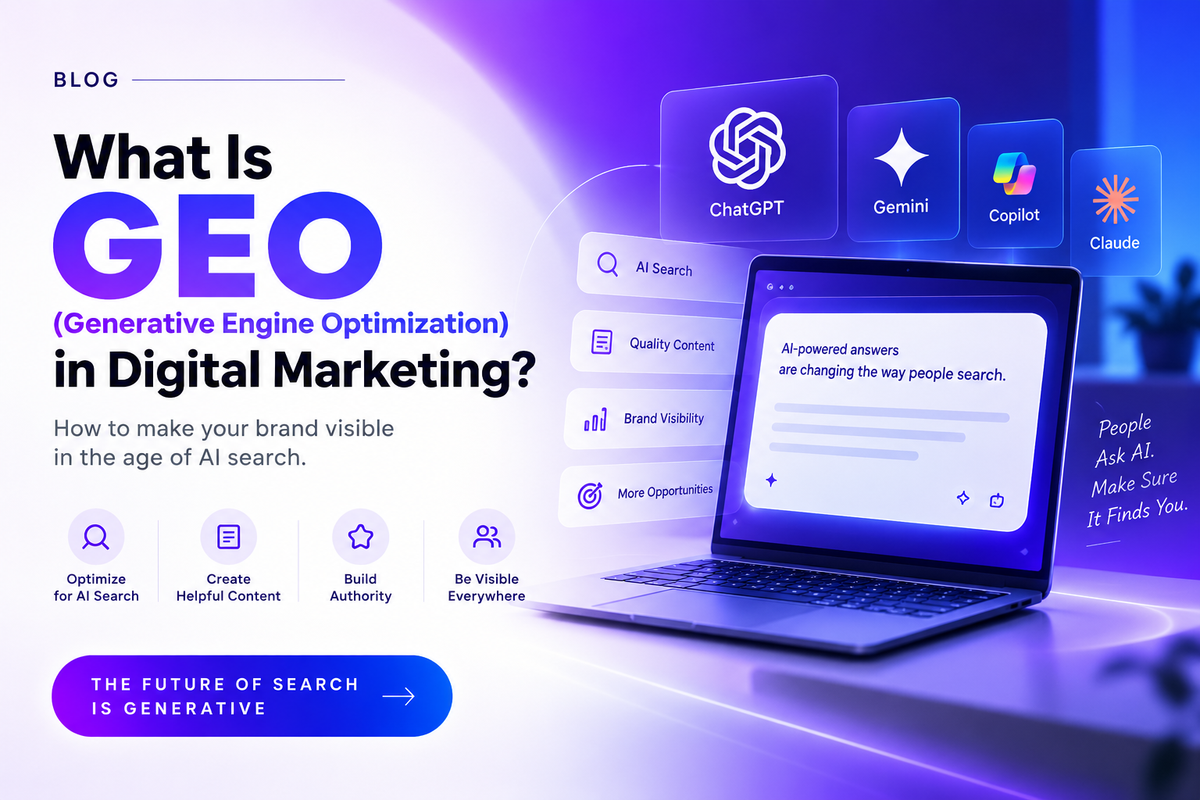
What Is GEO (Generative Engine Optimization) in Digital Marketing?
Search is changing.
For years, businesses focused primarily on ranking their websites on Google through Search Engine Optimization (SEO). Today, people are also using AI-powered platforms to research products, compare services, discover businesses, and get direct answers.
This shift has introduced a new digital marketing strategy known as Generative Engine Optimization (GEO).
GEO focuses on making your brand, website, expertise, and content easier for AI-powered search and answer engines to understand, trust, reference, and recommend.
But what exactly is GEO, how does it work, and how is it different from traditional SEO?
Let's break it down.
What Is GEO (Generative Engine Optimization)?
Generative Engine Optimization (GEO) is the process of optimizing digital content and brand information so that it can be accurately understood and potentially referenced, cited, or recommended by AI-powered search and generative answer systems.
Instead of optimizing only for traditional search engine rankings, GEO considers how information is discovered and synthesized by AI-driven experiences.
The objective is simple:
Make your business a clear, credible, and useful source when AI systems generate answers related to your industry, services, products, or expertise.
For example, a potential customer might ask an AI search tool:
- “What is the best way to improve local SEO?”
- “How do I choose a digital marketing agency in Madurai?”
- “What should a small business do to rank on Google?”
- “SEO vs GEO: which one does my business need?”
- “Which digital marketing strategies generate local leads?”
Businesses with strong, authoritative, well-structured digital footprints may have a better chance of being discovered or referenced in AI-generated responses.
Why Is GEO Becoming Important in Digital Marketing?
Traditional search usually follows this journey:
Search → Search Results → Website → Answer
Generative search can shorten that journey:
Question → AI-Generated Answer
Instead of opening multiple websites and manually comparing information, users can ask detailed questions and receive summarized responses.
This creates a new challenge for businesses.
Ranking on Google remains important, but businesses increasingly need to think beyond traditional blue-link rankings.
Your brand should be understandable across:
- Search engines
- AI-powered search experiences
- Generative answer engines
- Business listings
- Trusted third-party websites
- Reviews and citations
- Your own website and content
This is why GEO should be viewed as an extension of a strong SEO and digital authority strategy, rather than simply a replacement for SEO.
How Does Generative Engine Optimization Work?
AI systems need clear, relevant and trustworthy information to formulate useful answers.
GEO therefore focuses on improving how easily machines can understand:
Who you are
What your business does
Where you operate
What topics you have expertise in
Why your information should be trusted
How your business relates to specific questions and user needs
For a digital marketing agency, for example, the website should clearly establish relationships between the company and topics such as:
Digital Marketing → SEO → Local SEO → Google Business Profile → Content Marketing → GEO → AEO → Website Optimization
Clear topical relationships make the website easier for both search engines and AI systems to interpret.
SEO vs GEO: What's the Difference?
SEO GEO
Search Engine Optimization Generative Engine Optimization
Targets traditional search engines Targets AI-driven search and answer experiences
Focuses heavily on search rankings Focuses on AI visibility, understanding and references
Uses keywords and search intent Uses topics, entities, context and user questions
Builds backlinks and authority Builds broader brand and topical authority
Optimizes pages for SERPs Optimizes information for retrieval and generated answers
Measures rankings, clicks and organic traffic
Can also consider AI mentions, citations and referral visibility
The two strategies overlap significantly.
A technically strong, authoritative, well-structured website usually provides a better foundation for both SEO and GEO.
Therefore, businesses shouldn't think:
SEO OR GEO
A better approach is:
SEO + GEO + AEO
SEO helps people find you in search.
AEO helps your content answer questions clearly.
GEO helps improve your brand's visibility and usability within generative search experiences.
What Is the Difference Between GEO and AEO?
GEO and AEO are closely related, but they aren't exactly the same.
Answer Engine Optimization (AEO) focuses on structuring content so that search and answer systems can quickly identify a direct response to a user's question.
For example:
What is Local SEO?
Local SEO is the process of improving a business's online visibility for geographically relevant searches, particularly across search engines, maps and local business results.
That concise structure is useful for AEO.
Generative Engine Optimization, meanwhile, takes a broader view. It considers whether your overall content, expertise, entities, evidence, authority and brand presence make you a useful source for AI-generated responses.
A strong strategy can use both.
10 Ways to Optimize Your Website for GEO
1. Understand Search Intent
Don't create content purely around keywords.
Understand the actual questions behind those keywords.
Instead of creating only:
“Digital Marketing Agency Madurai”
build supporting content around questions such as:
- What does a digital marketing agency do?
- How much does digital marketing cost in Madurai?
- How do I choose a digital marketing agency?
- Does digital marketing work for small businesses?
- Should I choose SEO or Google Ads?
- How long does SEO take?
- What is GEO in digital marketing?
This builds stronger topical coverage.
2. Create Helpful, In-Depth Content
AI visibility isn't about repeating a keyword dozens of times.
Content should provide genuine information.
A strong article should answer:
What?
Why?
How?
When?
Who is it for?
What are the alternatives?
What should the reader do next?
This also makes your content more useful to human visitors.
3. Give Direct Answers
Don't hide the answer underneath several paragraphs of introduction.
For important questions, provide concise definitions first and expand afterward.
For example:
What is Generative Engine Optimization?
Generative Engine Optimization is the practice of improving digital content and brand signals so AI-powered search and answer systems can more easily understand, retrieve and potentially reference the information.
The following paragraphs can then provide examples, context and supporting details.
4. Build Topical Authority
Publishing one article about GEO doesn't automatically establish expertise.
Create interconnected content around the subject.
For example, a digital marketing website could develop a content cluster around:
GEO
- What is Generative Engine Optimization?
- GEO vs SEO
- GEO vs AEO
- How to optimize content for AI search
- How AI is changing SEO
- How businesses can appear in AI-generated answers
- Local SEO and AI search
- Structured data for AI search
- Brand authority in generative search
Link these articles naturally to relevant service and pillar pages.
This helps establish a clearer topical ecosystem.
5. Strengthen Your Brand Entity
AI systems should be able to clearly determine what your business represents.
Maintain consistent information about your:
- Business name
- Services
- Location
- Website
- Business description
- Expertise
- Founder or team
- Social profiles
- Business listings
Consistency across the web strengthens the connection between your brand and the topics you want to be known for.
For a local business, accurate business information and local citations remain especially valuable.
6. Demonstrate Experience and Expertise
Generic AI-generated articles are becoming increasingly common.
Businesses can differentiate their content by adding original information such as:
- Case studies
- Project results
- Customer questions
- Expert commentary
- Original research
- First-hand experience
- Before-and-after comparisons
- Industry observations
- Processes and frameworks
- Real examples
Instead of saying:
“SEO can improve local visibility.”
A stronger article might explain a real strategy, what was changed, how long implementation took, what metrics were monitored and what happened afterward.
Original experience gives readers—and potentially retrieval systems—information that isn't simply duplicated everywhere else.
7. Use Structured Content
Make pages easy to understand.
Use:
H1 → H2 → H3
along with:
- Short paragraphs
- Tables
- Definitions
- Lists
- FAQs
- Comparisons
- Statistics
- Examples
- Clear conclusions
Well-structured content improves readability while making individual passages easier to interpret.
8. Use Relevant Structured Data
Schema markup can provide search engines with additional structured information about a page or business.
Depending on the page, appropriate schema types may include:
- Organization
- LocalBusiness
- Article
- BreadcrumbList
- Product
- Service
- Person
- Event
Use schema only when it accurately represents visible page content and follows applicable search-engine guidelines.
Schema isn't a magic GEO ranking button, but structured information can contribute to a clearer machine-readable web presence.
9. Build Authority Beyond Your Website
GEO isn't limited to what you publish on your own domain.
A credible digital footprint can include:
Website + Google Business Profile + Business Directories + Reviews + Social Profiles + Industry Publications + PR + Relevant Backlinks + Expert Mentions
When independent sources consistently associate a brand with a particular topic or service, that can strengthen its overall digital authority.
For local businesses, this also reinforces geographic relevance.
10. Keep Your Information Updated
Outdated information reduces usefulness.
Regularly review:
- Statistics
- Pricing information
- Service descriptions
- Business details
- Team information
- Tools mentioned
- Case studies
- Industry developments
- External references
Content maintenance should become part of your SEO and GEO workflow rather than something you do only when traffic drops.
Can GEO Help Local Businesses?
Yes. GEO can be particularly relevant for businesses whose customers research extensively before contacting them.
Imagine someone asks:
“How do I choose an SEO agency in Madurai for my small business?”
A generative system may need to understand several things:
Service: SEO agency
Location: Madurai
Customer: Small business
Intent: Commercial research
Need: Choosing a provider
A local agency with strong location signals, detailed service pages, useful educational content, reviews, citations, case studies and consistent brand information is providing much stronger context than a website with only a homepage and contact page.
This is where Local SEO and GEO can work together.
Does GEO Replace SEO?
No.
GEO should not be treated as the death of SEO.
Search engines still provide enormous discovery opportunities, and many of the foundations that support traditional SEO also support broader AI discoverability:
- Crawlable websites
- Fast pages
- Helpful content
- Search intent alignment
- Internal linking
- Backlinks
- Brand authority
- Structured information
- Entity consistency
- Original expertise
The evolution is from optimizing exclusively for rankings toward optimizing for discoverability across both search and AI-driven experiences.
What Should Businesses Focus on First?
If you're starting from scratch, don't chase every new AI optimization tactic.
Start with the fundamentals:
1. Build a technically strong website
2. Clearly explain your services
3. Target relevant search intent
4. Build strong service and location pages
5. Publish genuinely useful content
6. Demonstrate real expertise
7. Strengthen brand and local authority
8. Use structured data appropriately
9. Build trustworthy external mentions
10. Expand into GEO and AEO systematically
The strongest GEO strategy starts with a strong digital foundation.
Frequently Asked Questions About GEO
What does GEO stand for in digital marketing?
GEO stands for Generative Engine Optimization. It refers to optimizing digital information so that AI-powered search and generative answer systems can more easily understand and potentially reference a brand or its content.
Is GEO the same as SEO?
No. SEO primarily focuses on visibility within traditional search results, while GEO focuses on visibility and representation within generative search experiences. However, the strategies overlap considerably.
Is GEO better than SEO?
Neither should automatically replace the other. Businesses can combine SEO, AEO and GEO to increase visibility across traditional and AI-powered discovery channels.
How do I optimize content for generative AI search?
Create clear, authoritative and well-structured content that directly answers user questions. Strengthen topical authority, demonstrate real experience, maintain consistent brand information, use credible sources where appropriate, improve technical SEO and build trustworthy external mentions.
Can GEO help small businesses?
Yes. Small businesses can use GEO alongside Local SEO to strengthen their online authority, particularly when potential customers use AI tools to research services, compare solutions or understand buying decisions.
How long does GEO take to work?
There is no guaranteed timeline. Results depend on factors including website authority, content quality, technical accessibility, competition, brand recognition and how different AI/search platforms retrieve information.
Can I guarantee my business will appear in AI answers?
No. Businesses cannot guarantee inclusion in AI-generated responses. GEO is about improving the quality, clarity, authority and accessibility of information so that a brand has stronger signals for discovery and retrieval.
The Future of Search Is Search + AI
Digital discovery is becoming more fragmented.
Customers may discover a business through Google, Maps, social media, an AI assistant, an AI-powered search engine, a recommendation, a review platform or a combination of several channels.
Businesses therefore need to move beyond thinking only about:
“How do I rank #1 for this keyword?”
The bigger question is:
“How do I make my business easy to find, understand, trust and choose wherever customers search?”
That is where SEO, AEO and Generative Engine Optimization come together.
Build Your SEO + GEO Strategy with Static Savvy Media
At Static Savvy Media, we help businesses strengthen their digital presence through SEO, Local SEO, content strategy, website optimization and emerging search strategies such as GEO and AEO.
Our approach focuses on one simple objective:
Be Found. Be Trusted. Be Chosen.
Whether customers discover your business through traditional Google search or emerging AI-powered discovery experiences, your digital presence should clearly communicate who you are, what you do and why customers should choose you.
If you're looking to prepare your business for the next generation of search, start by building a strong SEO foundation—and then expand your visibility for the AI-driven search ecosystem.